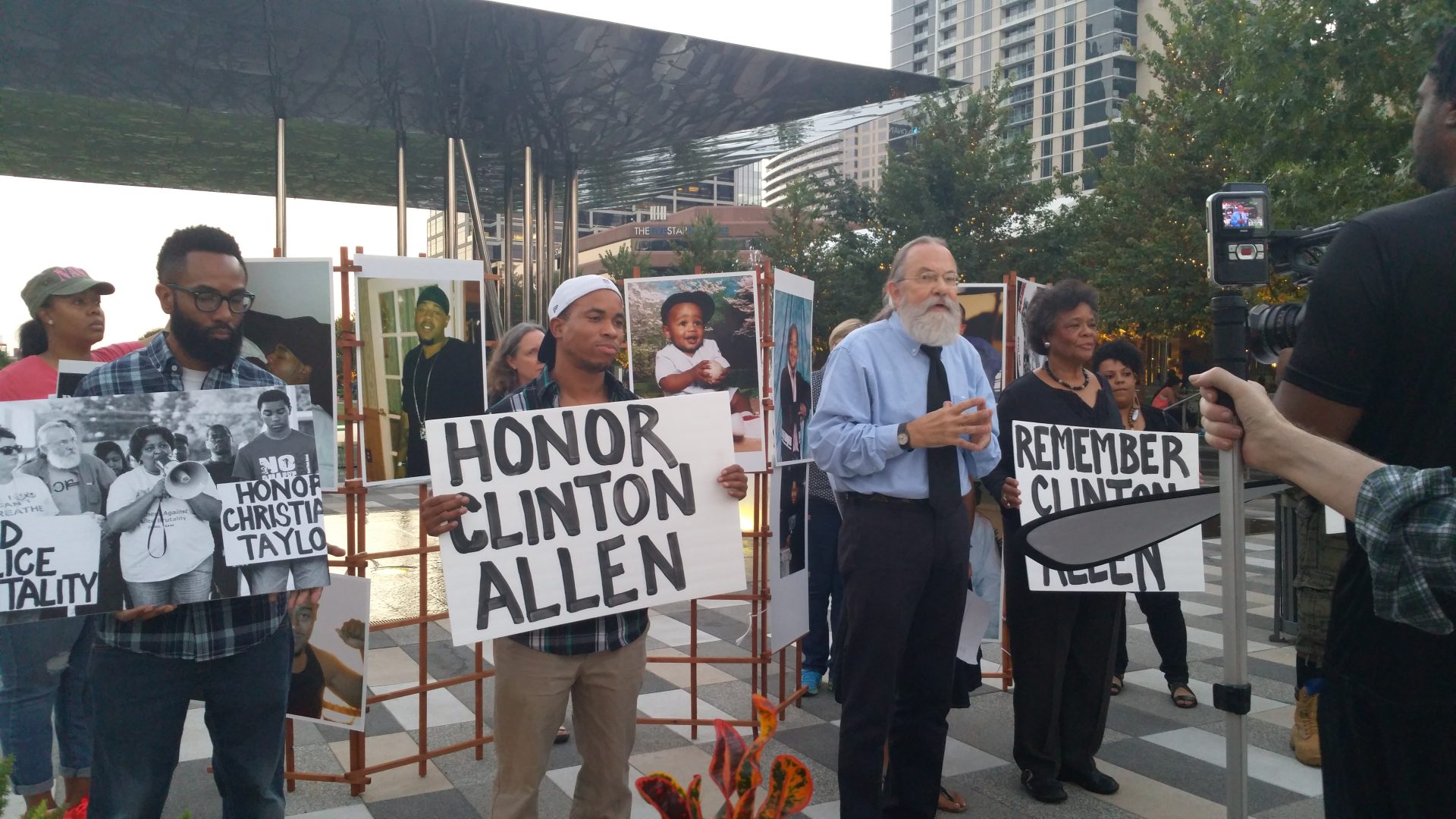

Mothers Against Police Brutality
Request for a Department of Justice Investigation of the Dallas Police Department
October 10, 2024

Executive Summary
Introduction: Our request describes a long history of impunity in officer-involved-shootings (OIS), custody deaths, and non-fatal violence. This half century of unaccountable police brutality created within the Dallas Police Department (DPD) a culture of racialized violence and abuse of citizens that persists, despite the employment from time to time of police chiefs who offer soothing rhetoric and promises of reform after violent encounters.
We found disproportionate impacts on people of color across seven categories of policing that involve use of force or DPD’s investigation of misconduct complaints. Former U.S. Department of Justice officials said our findings of poor internal investigative practices by DPD are similar to those discovered by DOJ investigators in other major cities’ troubled police departments.
Deadly Force: We reviewed the lack of accountability throughout the 1970s and 80s, years in which DPD killed more of the city’s residents per capita than New York, Los Angeles, Philadelphia, Baltimore, Chicago, Detroit, Houston, and San Antonio. We examined a dataset of officer involved shootings (OIS) for the years 2003-2017, analyzing 231 shootings involving 238 individual subjects. An OIS is not always fatal; an officer may wound a subject or shoot and miss. The data for this period show:
1. Black citizens (24 percent of Dallas population) are most likely to be the victims of an OIS, representing 49 percent of the individuals on whom officers used deadly force (see Table 1 in the full text). When these individuals are unarmed, Black individuals represent 59% of the total (Table 3).
2. Black citizens are also most likely to be the victims of fatal police shootings, making up 47% of people shot to death by Dallas officers. In fatal DPD shootings, Black and Latino residents together comprise 71 percent of the total death toll (Table 1.1)
3. When Dallas police used deadly force during this period, about 1/3 of the time the subject was killed (75 outcomes, 32%). About 1/3 of the time the subject was injured (72 outcomes, 31%). Of the total, 83 outcomes involved officers who reported shoot-and-miss incidents (36%) (Table 2.). Deadly force by law and policy is limited to situations in which an officer perceives he, or a bystander, is in danger of serious injury or death. In shoot-and-miss OISs, we found in the vast majority of cases, officers were not killed or injured, suggesting that officers are using deadly force when there is no imminent threat.
4. We extended our historical analysis to include the years 2018-2022. In these years, 57 percent of people killed were Black. Taken together, Black and Latino citizens represent more than 90% of those shot to death. Officers continued to shoot and miss more than 1/3 of the time (39 percent).
Deaths in Custody: During the period April 2017- June 2023, a death in custody occurred about every 10 weeks. More than 3/4 of the people who died were Black (42 percent) or Latino (36 percent). More than 1/3 of cases involved “pre-custodial use of force” (36 percent). Two-thirds of the deaths involved restrains with handcuffs (67 percent). At least 3 deaths involved officers’ use of a Taser.
Internal Affairs Department (IAD) investigations do not conform to best practice guidelines of the DOJ and enable officers with long histories of violence to stay on the job. The department’s disciplinary data, stretching back more than five decades, reflects that officers get pass after pass. A total of more than 29,000 cases of alleged misconduct is contained in the database we are sharing with the DOJ. This database, which has never been made public, documents the following:
- Of just over 3,000 cases of excessive force handled by the department, investigators determined there was wrongdoing in only 6% of the cases.
- In all that time, only 116 of the excessive-force cases – less than 4% – resulted in a recommended punishment of suspension, demotion, or termination. In 29 of these cases the punishments were later reduced. Only 31 cases where a punishment was recommended actually resulted in a termination, and that number dropped to 14 after removing cases that were later reduced or reclassified.
- Of all misconduct complaints where race was identified, including excessive force, 54% of those who brought allegations were Black, though Blacks comprise only about 24% of the city’s population. Blacks and Latinos together accounted for 78% of excessive force complaints in cases where race was identified (Chart 1).
- Nine Dallas police officers who faced the most excessive force investigations over the last five decades – 137 cases combined – were cleared of wrongdoing in every case except two. Those officers also received an above average number of commendations.
- Sixteen officers including Christopher Hess averaged one or more excessive force cases per year. Hess has amassed 40 misconduct complaints in his 10-years career, including the 2014 beating of a Black man, Terry Morris, an assault that experts described as “torture.” Three years later Hess fired 12 shots into a suspected stolen car, killing the unarmed driver, Genevive Dawes, a Latina mother of two.
- Nearly 1 in 4 former and current Dallas officers, or 23%, have 1 or more complaints of excessive force
- Although the percentage of excessive force cases sustained – or substantiated – by police is extremely low, white people have the highest percentage of complaints sustained (7.14%), nearly twice the rate of Black complainants (Chart 2).
DPD allows officers to accumulate multiple excessive-force complaints and remain on the force year after year, despite the fact that officers who are part of this trend have a record of unlawfully killing civilians.
Rhetoric of Reform vs. Reality: DPD and the City of Dallas have proven incapable of reforming the department. One of the latest “reforms” was creation of a Community Police Oversight Board in 2019. Yet due to poor funding and a highly restrictive ordinance, the board is stymied from performing independent, robust and timely investigations. For instance, the CPOB cannot conduct formal investigations into officer-involved shootings or other serious uses of force until the DPD completes its own investigations and determines whether discipline is needed – a process that can drag on for more than a year. The oversight board’s former chairman, Jesuorobo Enobakhare Jr., described its work last year as “exercises in futility.”
Dallas City Hall chokes off the flow of information about police misconduct by routinely violating public records law. At least 60 times over the last three years, the city has failed to meet state-imposed deadlines to turn over public records needed to form an accurate picture of excessive-force trends. Frequently, when the city does release comprehensive documentation so much time has passed that key positions in police or city leadership have changed and the new officials dismiss problems as old issues that are no longer relevant. Privately, law enforcement officials and police associations also have attempted to intimidate and discredit those who expose evidence of department shortcomings while pointing to the agency’s “positive” attributes and the record of their latest “new” chief.
In Dallas, the pervasive police “code of silence” has been embraced by leaders across the political spectrum. City officials rarely discuss excessive force issues publicly, refusing to answer the most basic questions. Law enforcement officials and civic leaders frequently resort to diversionary tactics when serious concerns about use of force arise. An extrajudicial killing by a police officer is typically termed a “tragedy,” not a crime; “regrettable,” not preventable.
Conclusion: Our request is for the Justice Department to conduct an investigation of the Dallas Police Department’s pattern and practice of unlawful conduct that violates residents’ constitutional rights. We believe that only through a federal investigation will the city’s leadership seriously confront the through line of accountability failures in its police force and take meaningful steps to prevent the department from doing further harm to the public, to people of color.